6 Asymmetric Cryptography and RSA
Introduction
Symmetric ciphers, from the classical ciphers to AES, and HMAC as well, share a structural limitation: they require a secret key shared in advance between sender and receiver. Suppose Alice wants to send Bob, in another city, a file encrypted with AES:
- AES needs a key \(K\) known to both of them.
- If Alice sends \(K\) over the Internet, unprotected, an attacker (Darth) reads it on the way.
- To encrypt \(K\), Alice would need another key, already agreed with Bob, and the problem repeats itself.
- Meeting in person does not scale: in a company with 1000 people, each pair needs its own key, that is, \(1000 \times 999 / 2 = 499\,500\) keys.
This is the key distribution problem, and for decades it had no satisfactory answer. The solution, proposed by Diffie and Hellman in 1976 and made concrete by Rivest, Shamir and Adleman in 1977 with the algorithm that gives this chapter its name, is radical: instead of a shared key, each participant now has two mathematically related keys, one that can be freely disclosed and another that is never revealed to anyone.
6.1 Asymmetric Cryptography: the Concept
An analogy helps to grasp the idea. Bob buys many identical padlocks and hands them out open to anyone who asks, but keeps to himself the key that opens them. Alice puts the message in a box and locks it with one of Bob’s padlocks: locking only takes a push, no key is needed. Once locked, not even Alice can open the box; only Bob can.
In asymmetric cryptography, the open padlock is the public key (\(PU\)), which is disclosed to everyone, and the padlock’s key is the private key (\(PR\)), which never leaves its owner. A public-key system rests on six components (Stallings 2020):
| Component | Role |
|---|---|
| Plaintext \(X\) | the original message |
| Encryption algorithm \(E\) | transforms \(X\) using one of the keys |
| Ciphertext \(Y\) | what travels over the network |
| Decryption algorithm \(D\) | recovers \(X\) using the other key |
| Public key \(PU\) | known to everyone |
| Private key \(PR\) | known only to its owner |
The property that makes this useful is purely mathematical: whatever is encrypted with one key of a pair can only be decrypted with the other, never with the same one. In the notation used below, \(PU_b\) and \(PR_b\) are Bob’s keys, and \(PU_a\) and \(PR_a\) are Alice’s. Choosing which key to use for what gives rise to two distinct schemes, with opposite purposes.
Confidentiality. To send Bob a confidential message, Alice encrypts it with Bob’s public key (\(PU_b\)), which anyone knows:
\[Y = E[PU_b, X] \qquad X = D[PR_b, Y]\]
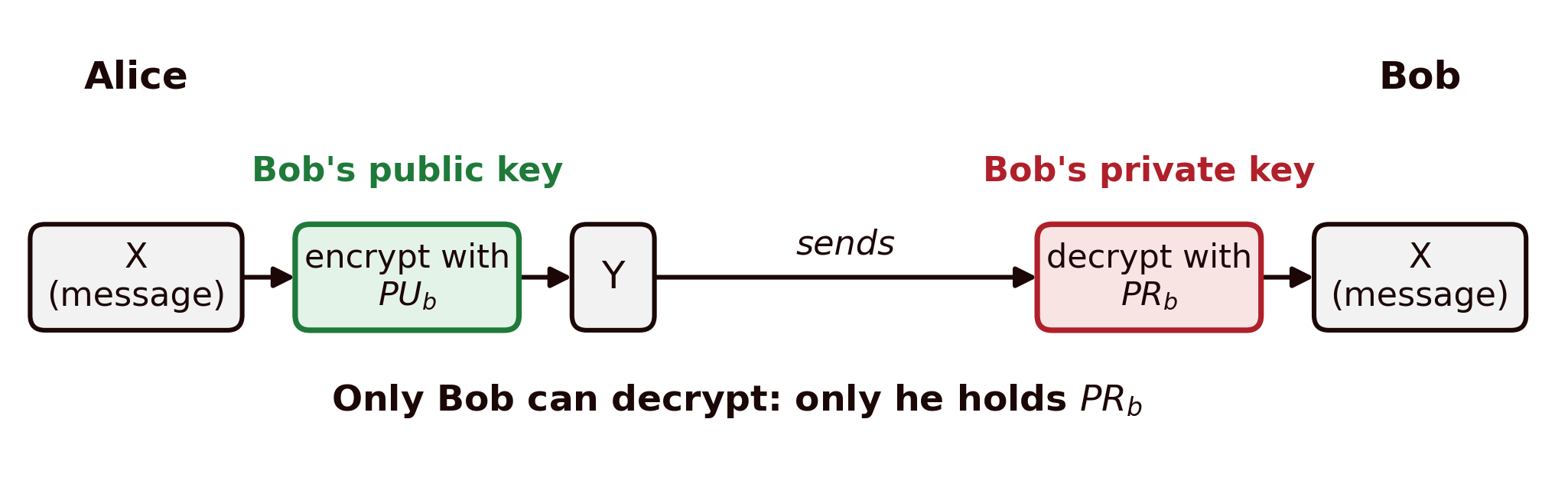
Only Bob can decrypt \(Y\), because only he has \(PR_b\). Darth also knows \(PU_b\), but cannot undo the encryption with it. This solves exactly the problem identified in the introduction: Alice never needed to agree on any secret with Bob, she only needed to know a key that is in plain sight.
Authentication. To prove that a message really comes from Alice, the keys swap roles: she encrypts it with her own private key (\(PR_a\)):
\[Y = E[PR_a, X] \qquad X = D[PU_a, Y]\]
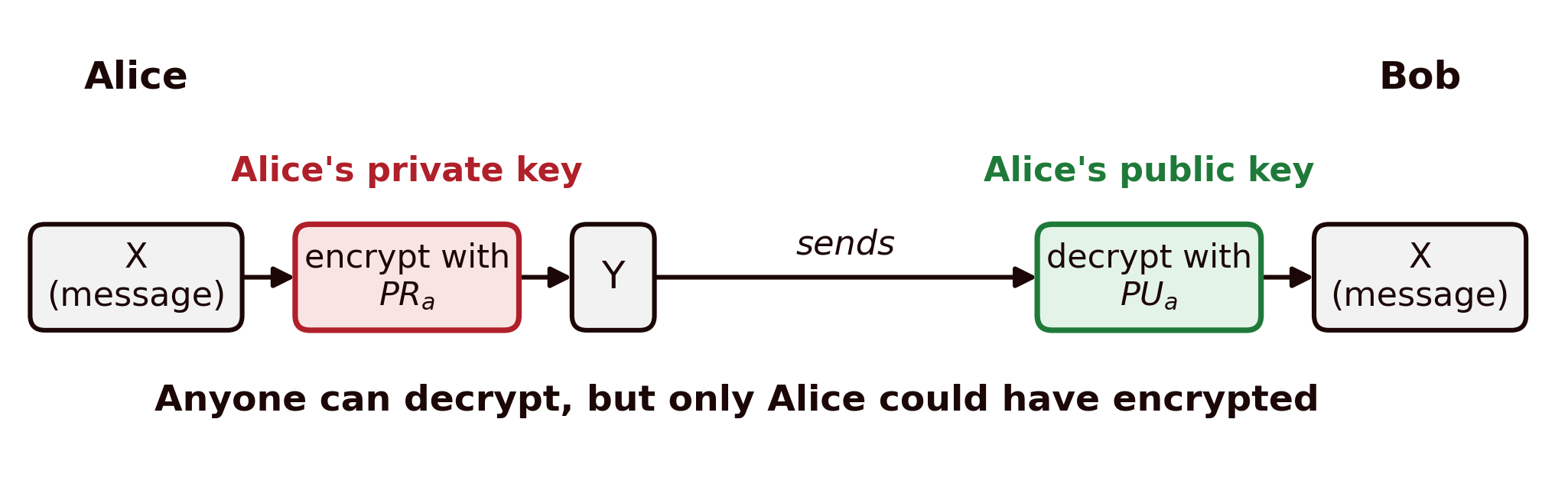
Anyone can decrypt \(Y\) with Alice’s public key, \(PU_a\), which is also freely known, and that is precisely why this scheme provides no confidentiality at all. What it provides is a guarantee of who sent it: if \(PU_a\) decrypts \(Y\), then \(Y\) was produced with \(PR_a\), and only Alice has it. This is the idea behind the digital signature.
Both at once. Nothing prevents combining the two schemes. Alice first encrypts with her own private key (signs) and then encrypts the result with Bob’s public key (ensures confidentiality):
\[Z = E[PU_b,\, E[PR_a, X]] \qquad X = D[PU_a,\, D[PR_b, Z]]\]
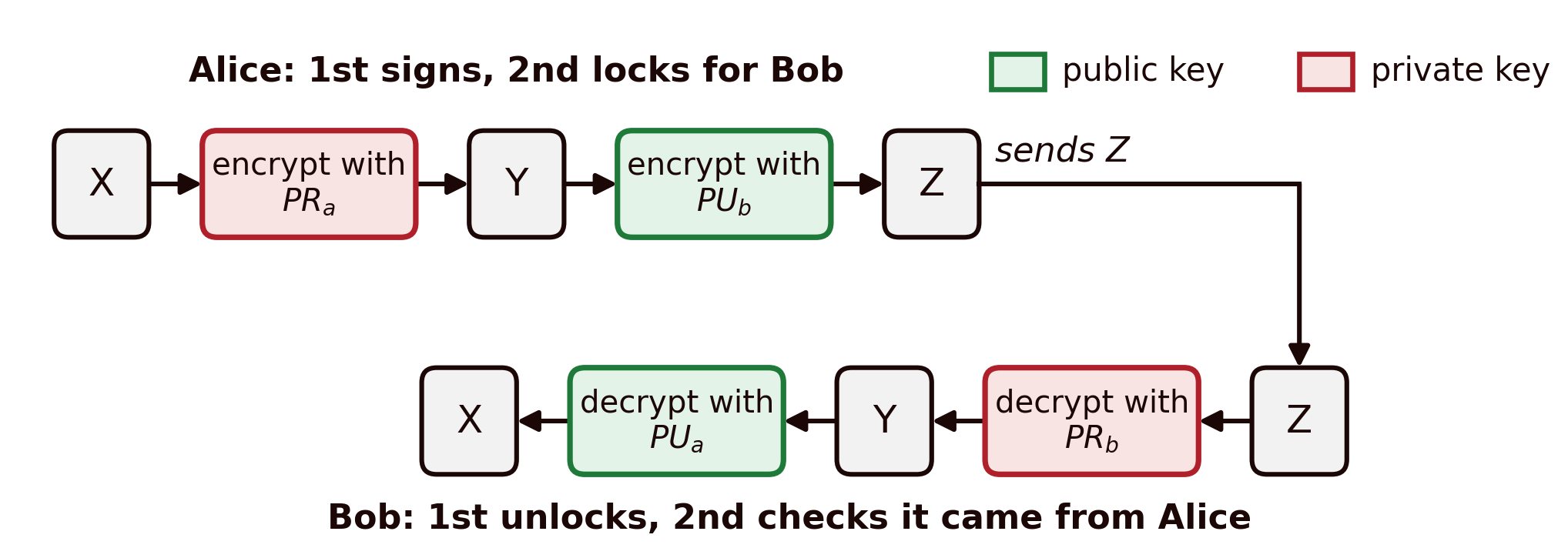
Only Bob can open \(Z\), and inside it he finds a \(Y\) that only Alice could have produced: he is certain the message came from Alice and has the guarantee that nobody else read it on the way.
6.2 Categories and Applications
Public-key algorithms have three possible uses:
- Encryption and decryption, to obtain confidentiality;
- Digital signature, to prove who produced a message;
- Key exchange, so that both parties end up sharing a secret key (for example, an AES key).
Not every algorithm serves all three:
| Algorithm | Encryption/Decryption | Digital Signature | Key Exchange |
|---|---|---|---|
| RSA | Yes | Yes | Yes |
| Elliptic Curve | Yes | Yes | Yes |
| Diffie-Hellman | No | No | Yes |
| DSS | No | Yes | No |
RSA, presented in this chapter, is, alongside elliptic-curve cryptography, able to serve all three roles. Diffie-Hellman serves only to agree on a shared key; DSS exists only to sign.
6.3 The Mathematics Needed
RSA uses only three arithmetic ideas, presented here before the algorithm.
The remainder of a division. \(a \bmod n\) is the remainder of the integer division of \(a\) by \(n\). A clock does this: 14 hours is 2 in the afternoon, because \(14 \bmod 12 = 2\). Likewise, \(200 \bmod 187 = 13\), because \(200 = 1 \times 187 + 13\), and \(161 \bmod 160 = 1\), because \(161 = 1 \times 160 + 1\). An important consequence: the result of “\(\bmod\ n\)” is always between \(0\) and \(n-1\), however large the starting number.
Primes and coprime numbers. A prime number is divisible only by 1 and by itself (2, 3, 5, 7, 11, 13, 17, …). The greatest common divisor, \(\gcd(a, b)\), is the largest number that divides both \(a\) and \(b\), and \(a\) and \(b\) are said to be coprime when \(\gcd(a, b) = 1\), that is, when they share no factor:
| Pair | Factors | gcd | Coprime? |
|---|---|---|---|
| 6 and 160 | \(6 = 2 \times 3\); \(160 = 2^5 \times 5\) | 2 | No |
| 7 and 160 | \(7\) is prime and does not divide 160 | 1 | Yes |
The modular inverse. In ordinary arithmetic, the inverse of 3 is \(\frac{1}{3}\), because \(3 \times \frac{1}{3} = 1\). In arithmetic modulo 160 there are no fractions: the inverse of 7 modulo 160 is the integer \(d\) such that
\[7 \times d \bmod 160 = 1\]
One therefore looks for a multiple of 7 that lies one unit above a multiple of 160:
| \(d\) | 1 | 2 | … | 22 | 23 |
|---|---|---|---|---|---|
| \(7 \times d\) | 7 | 14 | … | 154 | 161 |
| \(7 \times d \bmod 160\) | 7 | 14 | … | 154 | 1 |
The inverse of 7 modulo 160 is 23. This inverse only exists because 7 and 160 are coprime: with 6, which shares the factor 2 with 160, the products \(6 \times d\) are always even, and an even number minus a multiple of 160 never gives 1.
6.4 RSA: Key Generation
RSA (Rivest, Shamir and Adleman, 1977) remains the most widely used public-key algorithm in practice. Generating the key pair takes five steps:
- Choose two large random prime numbers, \(p\) and \(q\).
- Compute the modulus \(n = p \times q\), which will be public.
- Compute \(\phi(n) = (p-1)(q-1)\), which must be kept secret.
- Choose \(e\), coprime with \(\phi(n)\), with \(1 < e < \phi(n)\).
- Compute \(d\), the inverse of \(e\) modulo \(\phi(n)\): \(e \times d \bmod \phi(n) = 1\).
The public key is the pair \((e, n)\); the private key is the pair \((d, n)\). The modulus \(n\) is public, but \(p\), \(q\) and \(\phi(n)\) are never disclosed: whoever knows them can compute \(d\).
A complete example, with small numbers only so that the arithmetic can be done by hand:
- \(p = 17\) and \(q = 11\).
- \(n = 17 \times 11 = 187\).
- \(\phi(n) = 16 \times 10 = 160\).
- \(e = 7\), because \(\gcd(7, 160) = 1\).
- \(d = 23\), because \(7 \times 23 = 161\) and \(161 \bmod 160 = 1\) (Table 6.4).
Bob’s public key is \((7, 187)\) and his private key is \((23, 187)\).
6.5 RSA: Encryption and Decryption
In RSA, the message is a number \(M\), between \(0\) and \(n-1\); a text is converted into numbers, for example through the codes of its characters. Encrypting and decrypting come down to modular exponentiation:
\[C = M^e \bmod n \qquad\qquad M = C^d \bmod n\]
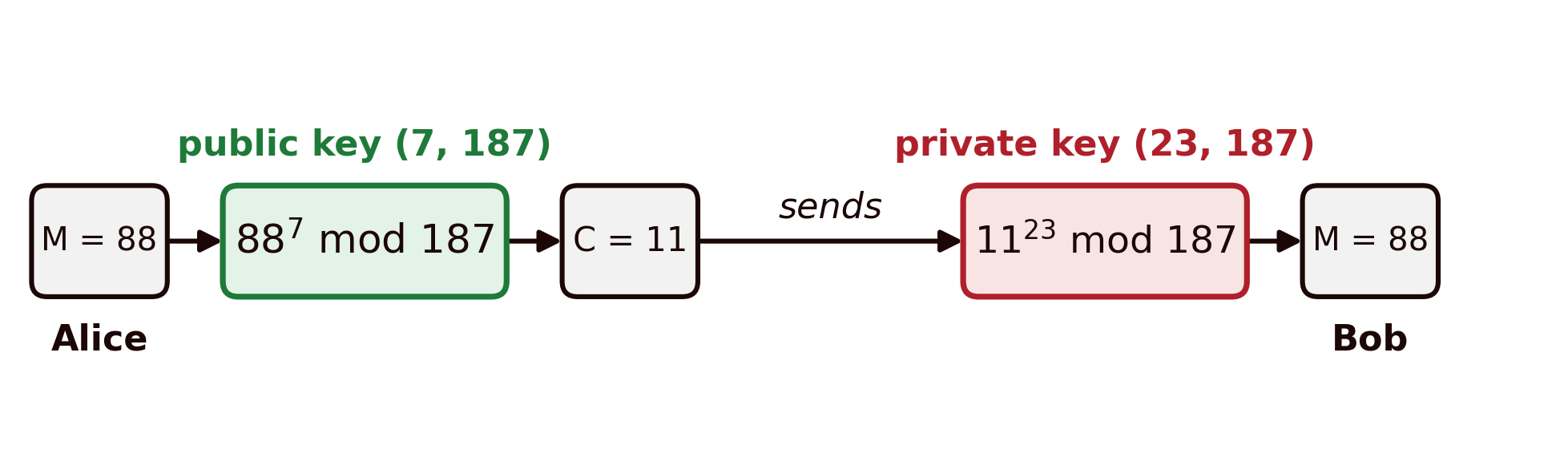
In the example, Alice encrypts \(M = 88\) with Bob’s public key, \(C = 88^7 \bmod 187 = 11\), and Bob decrypts with his private key, \(M = 11^{23} \bmod 187 = 88\).
6.5.1 Computing the Powers by Hand
\(88^7 = 40\,867\,559\,636\,992\) is already a large number, and with exponents hundreds of digits long a direct computation would be impossible. The trick is to reduce modulo \(n\) at every step:
- Split the exponent into powers of 2: \(7 = 4 + 2 + 1\), so \(88^7 = 88^4 \times 88^2 \times 88^1\).
- \(88^1 \bmod 187 = 88\).
- \(88^2 = 7744\), and \(7744 \bmod 187 = 77\).
- \(88^4 = (88^2)^2\), so it is enough to compute \(77^2 = 5929\), and \(5929 \bmod 187 = 132\).
- Multiply everything: \(132 \times 77 \times 88 = 894\,432\), and \(894\,432 \bmod 187 = 11\).
The intermediate numbers never go much beyond \(187^2\). This is how computers do it, even with an \(n\) thousands of bits long, and the method is called square-and-multiply (exponentiation by repeated squaring).
To decrypt, Bob does the same with the exponent \(d = 23 = 16 + 4 + 2 + 1\), always squaring the previous result:
| Power | \(11^1\) | \(11^2\) | \(11^4\) | \(11^8\) | \(11^{16}\) |
|---|---|---|---|---|---|
| \(\bmod 187\) | 11 | 121 | 55 | 33 | 154 |
\[11^{23} = 11^{16} \times 11^4 \times 11^2 \times 11^1 \;\rightarrow\; 154 \times 55 \times 121 \times 11 = 11\,273\,570, \qquad 11\,273\,570 \bmod 187 = 88\]
Bob has recovered Alice’s message.
6.5.2 Why Does It Come Back to 88?
Encrypting and then decrypting means raising to \(e\) and then to \(d\):
\[(M^e)^d = M^{e \times d} = M^{161}\]
\(e\) and \(d\) were chosen so that \(e \times d = 161 = 160 + 1\), that is, \(e \times d \bmod \phi(n) = 1\). With \(n = 187\), raising to 161 always returns the starting number, \(M^{161} \bmod 187 = M\):
| \(M\) | 2 | 5 | 88 |
|---|---|---|---|
| \(C = M^7 \bmod 187\) | 128 | 146 | 11 |
| \(C^{23} \bmod 187\) | 2 | 5 | 88 |
The property holds for every \(M\) from 0 to 186. The general proof comes from number theory (Euler’s theorem) (Stallings 2020).
6.6 Security: Factoring \(n\)
In the example, Darth knows the public key, \(e = 7\) and \(n = 187\), the RSA algorithm and the ciphertext \(C = 11\). He does not know \(d = 23\), nor \(p = 17\) and \(q = 11\), nor \(\phi(n) = 160\). The chain of dependencies is as follows: to compute \(d\), he needs \(\phi(n)\); to compute \(\phi(n) = (p-1)(q-1)\), he needs \(p\) and \(q\); and to obtain \(p\) and \(q\), he has to factor \(n\), that is, find out which primes, multiplied together, give 187.
With \(n = 187\), the attack is immediate. Darth divides 187 by each prime, in order:
- \(187 \div 2\), \(187 \div 3\), \(187 \div 5\) and \(187 \div 7\): no division is exact.
- \(187 \div 11 = 17\): he has found \(p = 17\) and \(q = 11\).
- He computes \(\phi(n) = 16 \times 10 = 160\).
- He computes the inverse of \(e = 7\) modulo 160: \(d = 23\).
- He decrypts everything sent to Bob: \(11^{23} \bmod 187 = 88\).
It is enough to try primes up to \(\sqrt{187} \approx 13.7\), because if both factors were larger than that, their product would exceed 187. That is at most six divisions (2, 3, 5, 7, 11 and 13). Any 8-bit \(n\) (smaller than 256) falls this way: the security is nil.
In practice, \(n\) has 2048 to 4096 bits, a number with 617 to 1234 digits. The primes up to \(\sqrt{n}\) number more than \(10^{305}\), and trying them one by one is impossible. Multiplying \(p \times q\) is instantaneous, but undoing the multiplication has no known fast method: this is the integer factorisation problem, on which the whole security of RSA rests.
This does not mean that factoring can only be done by trial division. In 1991, the company RSA Laboratories published a list of moduli as a public challenge, with names of the form RSA-number of digits. The current record is RSA-250, with 250 digits (829 bits), factored in 2020: a single processor would have needed about 2700 years, and spread over thousands of computers it took a few months. The best known method, the General Number Field Sieve (GNFS), has subexponential complexity: it grows more slowly than an exhaustive search, but faster than a polynomial algorithm (Stallings 2020). It is the existence of this shortcut, much faster than trial division, that forces RSA to use keys far larger than those of a symmetric cipher for the same security level:
| Equivalent security (bits) | 112 (3DES) | 128 | 192 | 256 |
|---|---|---|---|---|
| Equivalent RSA modulus (bits) | 2048 | 3072 | 7680 | 15 360 |
6.7 A Real RSA Key
openssl generates and displays a 2048-bit RSA key pair:
$ openssl genpkey -algorithm RSA -pkeyopt rsa_keygen_bits:2048 -out bob.pem
$ openssl pkey -in bob.pem -text -noout
Private-Key: (2048 bit, 2 primes)
modulus:
    00:da:2c:3c:33:c6:c3:1a:7d:7a:e2:cc:af:74:48: ...
publicExponent: 65537 (0x10001)
privateExponent:
    61:44:4b:6a:c1:f8:85:bc:df:a6:71:9e:df:76:fa: ...
prime1:
    00:ee:f1:6c:4f:11:2f:fd:f9:8e:ba:17:29:c6:93: ...
prime2:
00:e9:bf:3e:ad:10:df:07:59:b3:ff:48:88:88:b0: ...| Command or field | Meaning |
|---|---|
genpkey -algorithm RSA |
generates a new RSA key pair |
-pkeyopt rsa_keygen_bits:2048 |
with a 2048-bit modulus \(n\) |
-out bob.pem |
saves the private key (which includes the public one) to bob.pem |
pkey -in bob.pem -text -noout |
displays the numbers of the key as text |
modulus, publicExponent, privateExponent, prime1, prime2 |
\(n\), \(e\), \(d\), \(p\) and \(q\) |
The values are in hexadecimal: each pair of characters is one byte, and the “:” only separate the bytes for readability; the leading 00 merely indicates that the number is positive. Read as a whole, the modulus is a single 2048-bit integer, which in decimal would have 617 digits. prime1 and prime2 are \(p\) and \(q\): whoever has them can compute \(d\), which is why the private key file is never shared.
The public exponent is \(e = 65\,537\) in almost every key in the world. \(e\) is fixed first, and only primes \(p\) and \(q\) for which \(p-1\) and \(q-1\) are not multiples of 65 537 are accepted, so that \(e\) is coprime with \(\phi(n)\). About one prime in every 65 536 fails, and it is simply replaced by another.
6.8 Textbook RSA and RSA-OAEP
Using RSA exactly as described, so-called textbook RSA, has a problem: \(C = M^e \bmod n\) always gives the same \(C\) for the same \(M\). Consider a vote encrypted with Bob’s public key, \((7, 187)\):
- Alice votes “Y” (code 89) or “N” (code 78) and sends \(C\) to Bob.
- Darth intercepts \(C = 166\).
- Darth also has the public key: he computes \(89^7 \bmod 187 = 166\) and \(78^7 \bmod 187 = 56\).
- He compares: \(166 = 166\), Alice voted “Y”.
Darth factored nothing, did not find \(d\), and still read the message. When there are few possible messages, encrypting each of them with the public key and comparing is enough. That is why no serious cryptographic library uses RSA this way.
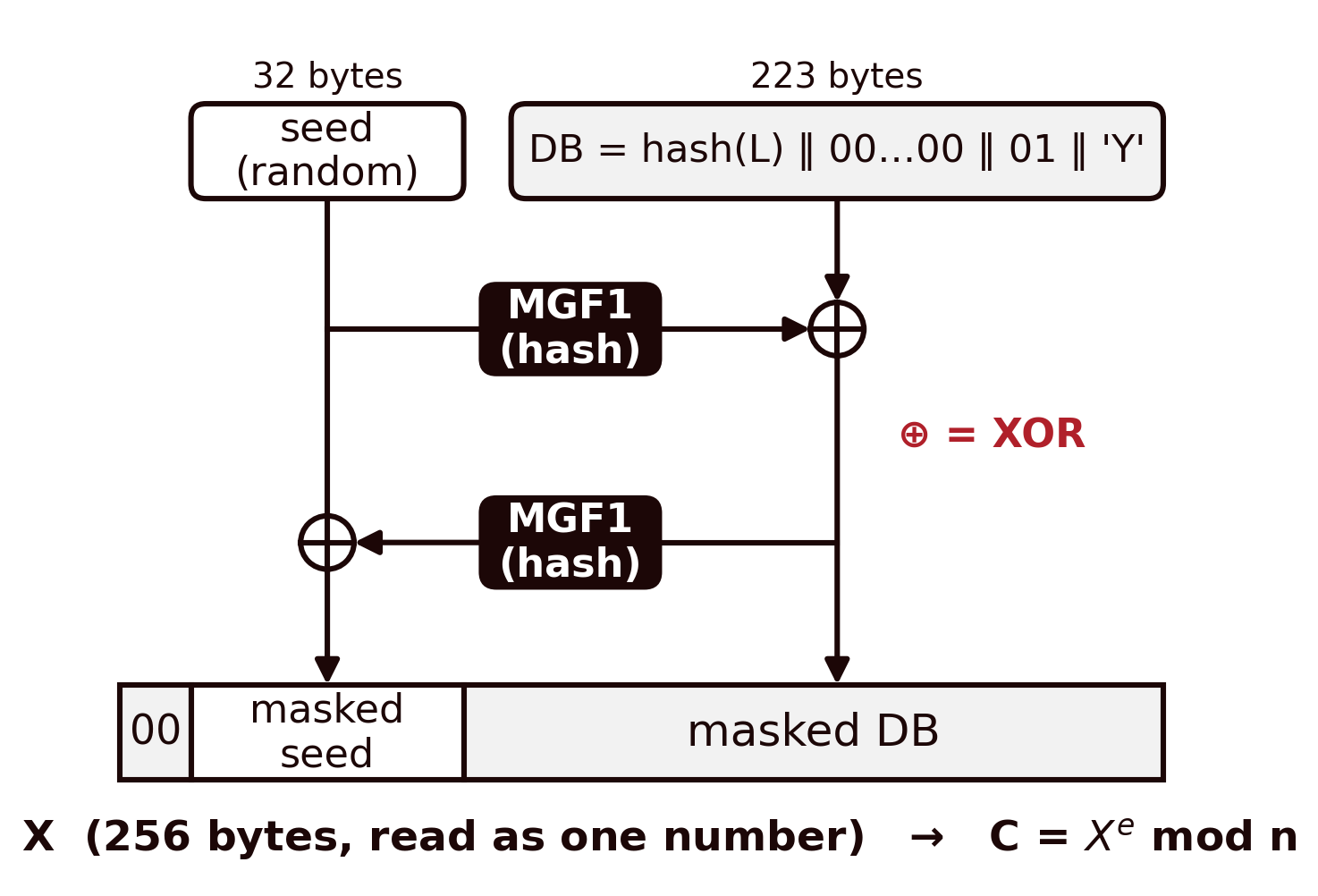
The solution is to add randomness before encrypting. In RSA-OAEP (Optimal Asymmetric Encryption Padding), the message is hidden by an XOR with bytes that depend on a random value. With a 2048-bit key and SHA-256:
- Alice generates 32 fresh random bytes, the seed, for this message only.
- She prepares the DB block (223 bytes): the vote, preceded by padding (the hash of a label \(L\), usually empty, 00 bytes and a 01 byte marking the start of the message).
- She applies the hash to the seed repeatedly (the MGF1 function) until she has 223 bytes, the mask, and computes the XOR: masked DB = DB \(\oplus\) mask.
- She also hides the seed, with an XOR against a mask computed in the same way from the masked DB.
- She concatenates 00, the masked seed and the masked DB: 256 bytes, read as a single number \(X\), which is encrypted with ordinary RSA, \(C = X^e \bmod n\).
MGF1 (Mask Generation Function 1, defined in the PKCS #1 standard, RFC 8017) produces, from an input \(Z\), a mask of any desired length, using only a hash function \(H\). It applies \(H\) to \(Z\) followed by a 4-byte counter starting at 0, and concatenates the results until it has enough bytes, cutting off the excess at the end (\(\Vert\) denotes concatenation):
\[\text{MGF1}(Z) = H(Z \Vert 0) \;\Vert\; H(Z \Vert 1) \;\Vert\; H(Z \Vert 2) \;\Vert\; \ldots\]
With SHA-256, each call yields 32 bytes: the 223-byte DB mask needs 7 calls (224 bytes, the last of which is discarded), and the 32-byte seed mask needs only one. MGF1 has no key and no secret: anyone who knows \(Z\) obtains the same mask, which is what allows Bob to recompute it. What is expected of it is that any change to \(Z\), however small, changes the whole mask unpredictably, just as with the hash itself.
To decrypt, Bob undoes these steps in reverse order:
- He computes \(X = C^d \bmod n\) and splits it at fixed positions: the 00 byte, the masked seed (32 bytes) and the masked DB (223 bytes).
- He recovers the seed: MGF1 applied to the masked DB gives the seed mask, and seed = masked seed \(\oplus\) mask.
- He recovers the DB: MGF1 applied to the seed gives the DB mask, and DB = masked DB \(\oplus\) mask.
- He checks the padding: the DB must start with the hash of \(L\), followed by 00 bytes and a 01 byte, and the first byte of \(X\) must be 00. If everything checks out, whatever follows the 01 is the message; otherwise, he rejects it.
This works because XOR cancels itself out, \((a \oplus m) \oplus m = a\), and because MGF1 has no secret at all: with the same input, Bob obtains exactly the same masks as Alice. The order is mandatory, because the DB mask can only be computed once the seed has been recovered. The two XORs protect nothing on their own: anyone holding \(X\) could undo them in the same way. What stops Darth from reaching \(X\) is the RSA layer, because only Bob has \(d\).
The DB was not designed to hide anything: it is padding with a public format, like the padding of a block cipher. It fills the 223-byte block, the 01 byte marks where the message starts (its length varies) and the rest provides redundancy for the check in step 4. Anyone who reached the DB would read the message, which sits there in the clear: confidentiality comes solely from the RSA layer.
The label \(L\) is optional: it does not travel inside \(C\), it is defined by the protocol Alice and Bob use, and it is almost always empty. In that case, the hash of \(L\) is a constant known to everyone, which adds no secret at all; it serves only as redundancy. Darth knows that value, but cannot make it appear in Bob’s DB if he alters Alice’s \(C\). In textbook RSA, such an alteration is easy and useful: with \(n = 187\) and \(e = 7\), multiplying the intercepted \(C = 11\) by \(2^7\), modulo 187, gives \(C' = 99\), and Bob decrypts \(99^{23} \bmod 187 = 176\), twice 88, without Darth ever having known the message. With OAEP, the \(X\) that Bob obtains with \(d\) changes in a way Darth cannot predict, and once the masks are removed the DB comes out scrambled and does not start with the expected value. This does not stop Darth from encrypting a message of his own, from scratch, with Bob’s public key: OAEP does not say who sent it, which is the job of digital signatures. Only when the protocol defines a non-empty label does \(L\) do more than this: a \(C\) produced in one context, for example with \(L\) = “Student Union Election 2026”, is no longer accepted in another. In openssl, the label is set with -pkeyopt rsa_oaep_label: followed by its value in hexadecimal, both when encrypting and when decrypting.
Because the seed is new for every encryption, so are the masks, and \(X\) and \(C\) come out completely different each time. Darth can encrypt “Y” and “N” as often as he likes and will never obtain Alice’s \(C\). For signatures, the corresponding scheme is called RSA-PSS (Probabilistic Signature Scheme).
openssl shows the effect: the same file vote.txt, containing only “Y”, encrypted twice with OAEP, gives two results with nothing in common:
$ openssl pkey -in bob.pem -pubout -out bob_pub.pem
$ openssl pkeyutl -encrypt -pubin -inkey bob_pub.pem \
      -pkeyopt rsa_padding_mode:oaep -pkeyopt rsa_oaep_md:sha256 \
      -in vote.txt | xxd -p | head -c 48
b0947d10a7c616e31e3c30b5b355d6ca91030e53ab074c63
$ openssl pkeyutl -encrypt -pubin -inkey bob_pub.pem \
      -pkeyopt rsa_padding_mode:oaep -pkeyopt rsa_oaep_md:sha256 \
      -in vote.txt | xxd -p | head -c 48
beef35280c44cfc8e078ab789e656c07cedd86565b1ca79e| Command or option | Meaning |
|---|---|
pkey -in bob.pem -pubout |
extracts only the public part, \((e, n)\), from the private key file and saves it to bob_pub.pem |
pkeyutl -encrypt |
encrypts a file with a key |
-pubin -inkey bob_pub.pem |
the key to use is public and is in bob_pub.pem |
-pkeyopt rsa_padding_mode:oaep |
applies OAEP before encrypting |
-pkeyopt rsa_oaep_md:sha256 |
OAEP uses SHA-256 (without this option, openssl uses SHA-1) |
-in vote.txt |
the file to encrypt |
xxd -p | head -c 48 |
shows the result in hexadecimal, only the first 24 of the 256 bytes |
\ at the end of a line |
the command continues on the next line |
6.9 In Practice: RSA Carries the AES Key
RSA is much slower than AES, and each block has to be a number smaller than \(n\): with 2048 bits, under 256 bytes. That is why, in practice, RSA encrypts only the AES key \(K\), once, and the data is encrypted with AES:
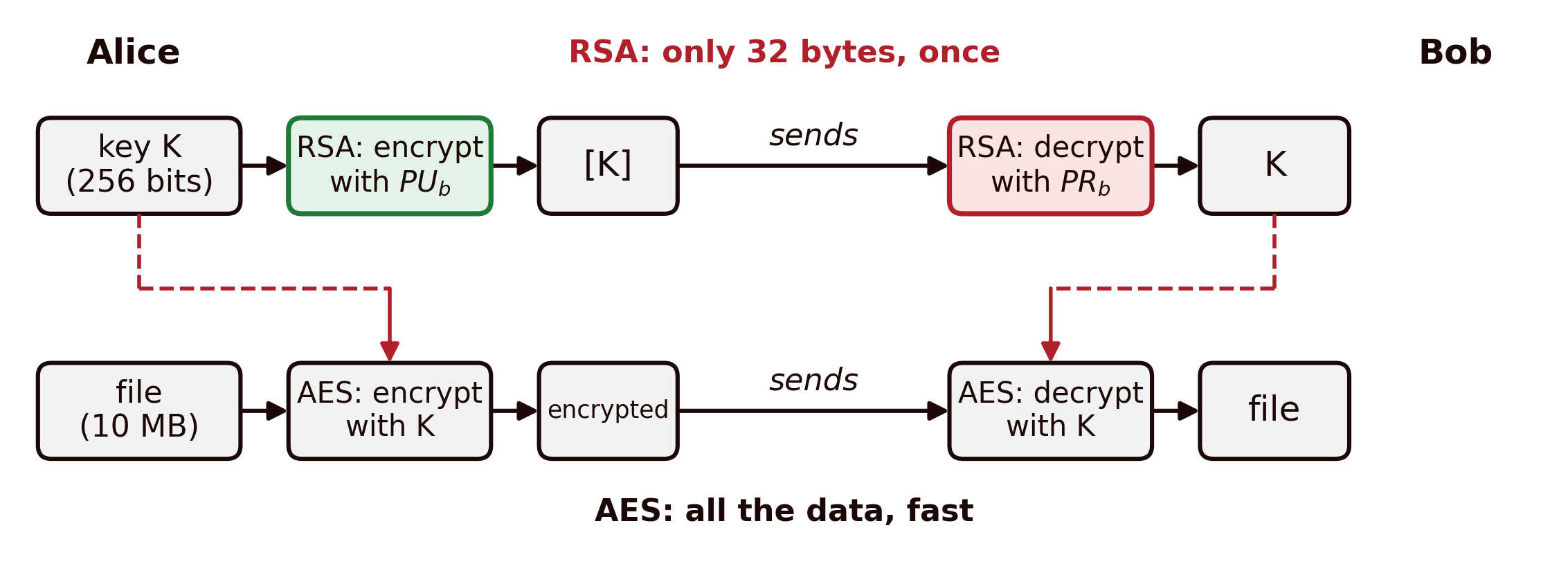
This is the answer to the problem in the introduction: Alice generates a random key \(K\), sends it to Bob encrypted with his public key, and from then on both use the fast symmetric cipher, with a key that never travelled in the clear.
6.10 Chapter Summary
- Each participant has a public key, disclosed, and a private key, secret; whatever one encrypts, only the other decrypts
- Encrypting with the recipient’s public key gives confidentiality; encrypting with one’s own private key proves who sent it; combining both gives both
- RSA and elliptic curves serve to encrypt, sign and exchange keys; Diffie-Hellman only to exchange keys, and DSS only to sign
- RSA: \(n = p \times q\), \(e\) coprime with \(\phi(n) = (p-1)(q-1)\), \(d\) the inverse of \(e\) modulo \(\phi(n)\); \(C = M^e \bmod n\) and \(M = C^d \bmod n\), computed by square-and-multiply
- Security depends on it being impractical to factor \(n\); with \(n = 187\) six divisions are enough, which is why in practice \(n\) has 2048 to 4096 bits
- Textbook RSA is deterministic: RSA-OAEP is used to encrypt and RSA-PSS to sign
- In practice, RSA encrypts an AES key, and AES encrypts the data
6.11 Food for Thought
The public exponent \(e = 65\,537\) is the same in millions of different RSA keys, without compromising any of them. In this chapter’s example (\(n = 187\)), if Bob replaced \(e = 7\) with a much larger \(e\), keeping the same \(n\), would the key become more secure? Why?