3 AES — Stages and Modes of Operation
Introduction
The previous chapter ended with an uncomfortable conclusion: DES, for decades the pillar of symmetric encryption, is obsolete, and 3DES, the stopgap solution, is slow and remains constrained by the 64-bit block inherited from the original. A successor designed from scratch, not patched together, was needed. This chapter presents that successor: AES (Advanced Encryption Standard), the symmetric cipher algorithm now universally adopted, from banking applications to communications protected by TLS. The second part of the chapter deals with a distinct, but equally practical question: a block cipher only encrypts one block at a time, so how does one encrypt a real message, almost always larger than that?
3.1 From DES to AES: a New Paradigm
In 1997, the United States’ National Institute of Standards and Technology (NIST) launched a public, open competition to choose the successor to DES, unlike the closed process that had originated DES itself two decades earlier. Any team, from any country, could submit an algorithm, which would then be publicly scrutinised by the entire worldwide cryptographic community.
Fifteen algorithms were submitted. Five reached the final round: MARS, RC6, Rijndael, Serpent and Twofish. In October 2000, NIST announced the winner: Rijndael, designed by the Belgian cryptographers Joan Daemen and Vincent Rijmen. The algorithm was formalised as a federal standard in 2001, under the name AES (National Institute of Standards and Technology 2001).
The most important structural difference from DES is not the size of the key or the block, it is the internal architecture. DES, as seen, is a Feistel network: in each round, only half of the block passes through the non-linear function \(F\), while the other half passes through virtually unscathed, merely combined by XOR. AES abandons this structure. It is a substitution-permutation network (SPN): in each round, the entire block is transformed, through a sequence of four distinct operations applied to all of its bytes.
3.2 Overall Structure of AES
Unlike DES, in which the block size (64 bits) and the key size (56 effective bits) are fixed by the standard, AES separates these two dimensions:
- Block: always 128 bits (16 bytes), regardless of key size.
- Key: 128, 192 or 256 bits, giving rise to three variants — AES-128, AES-192 and AES-256.
- Number of rounds: depends on the key size — 10 rounds for AES-128, 12 for AES-192, 14 for AES-256. Larger keys entail more rounds, because each additional round further hinders any attempt at statistical or algebraic analysis of the algorithm.
Internally, the 128-bit block is organised into a \(4 \times 4\) matrix of bytes, called the state, filled column by column: the first 4 bytes of the block occupy the first column, the next 4 the second, and so on. All round transformations operate on this matrix.
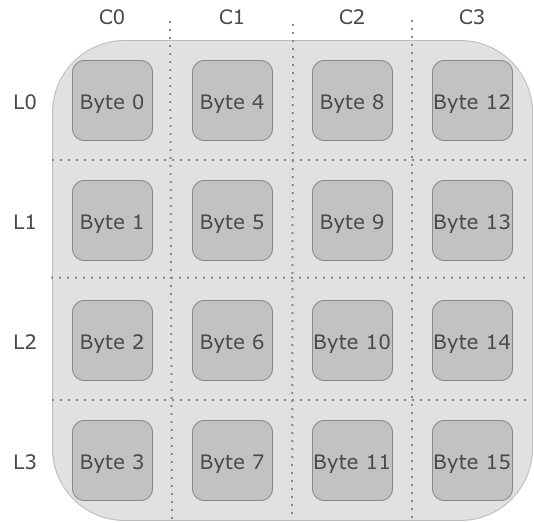
Pure AES is deterministic: the same plaintext block, with the same key, always produces the same ciphertext block. This predictability is unacceptable in practice — it is precisely the problem that, as will be seen later, requires resorting to a mode of operation, which introduces randomness through an initialization vector or nonce.
3.3 The Four Round Transformations
Each round of AES (except the last) applies, in this order, four transformations to the state matrix. Before the first round, an initial AddRoundKey is also applied, and the last round omits MixColumns. The purpose of these four operations is not merely to hide the original text, but to do so in such a way that a minimal change, a single bit, in the message or in the key, produces significant, unpredictable changes in the ciphertext — the so-called avalanche effect.
3.3.1 SubBytes
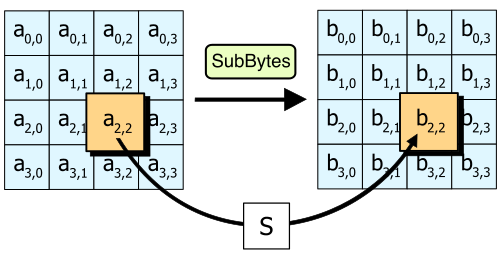
SubBytes is the only non-linear operation in AES, and it is the one that provides confusion: each byte of the state is replaced by the corresponding byte in a fixed substitution table, the S-box, constructed from the multiplicative inverse in the finite field \(GF(2^8)\) followed by an affine transformation. Unlike DES, which uses eight different S-boxes (one per group of 6 bits), AES uses a single S-box, reapplied byte by byte across the entire state matrix.
3.3.2 ShiftRows
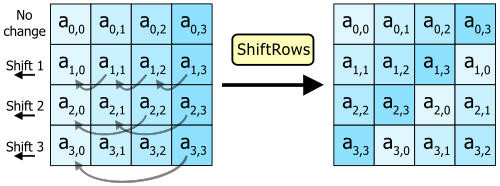
ShiftRows cyclically shifts each row of the state matrix to the left: row 0 is unchanged, row 1 shifts by 1 position, row 2 by 2 positions, row 3 by 3 positions. This operation is simple, but essential: it ensures that the bytes of a column no longer all belong to the same column, spreading the influence of each byte across several columns in subsequent rounds.
3.3.3 MixColumns
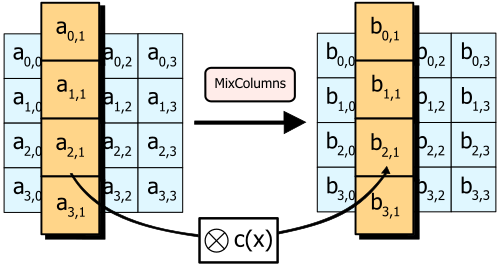
MixColumns operates on each column of the state matrix independently, treating it as a degree-3 polynomial over \(GF(2^8)\) and multiplying it by a fixed polynomial \(c(x)\), modulo \(x^4+1\). The practical effect is that each output byte of a column comes to depend on all four input bytes of that same column. Combined with the preceding ShiftRows, this ensures that, after just a few rounds, each output byte depends on every input byte of the block: this is the diffusion of AES. This transformation is omitted in the last round.
3.3.4 AddRoundKey
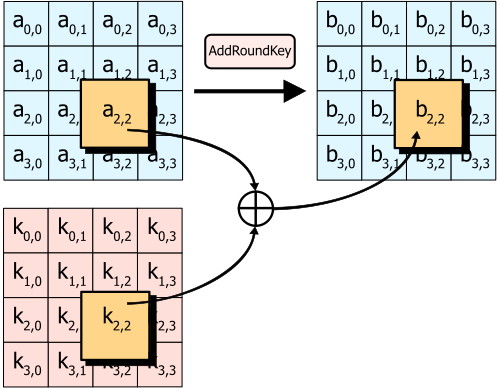
AddRoundKey is the only transformation that involves the key: each byte of the state is combined by XOR with the corresponding byte of that round’s subkey, derived from the main key by the key expansion schedule (key schedule). The other three transformations do not use the key: they are public, and anyone can undo them. They provide confusion, diffusion and nonlinearity, but on their own they provide no security at all. AddRoundKey, in turn, is the only step that cannot be undone without the key, but on its own it is also weak: it is an XOR with a fixed key, a kind of Vernam cipher, and knowing a single plaintext block and its ciphertext is enough to obtain the key with a single XOR. The security of AES comes from alternating the two: an XOR with the key, followed by the public scrambling of the other three transformations, followed by another XOR with the key, and so on (Stallings 2020). This is also why AES begins and ends with an AddRoundKey: any other step, placed at the beginning or at the end, would be public and could be undone without knowing the key, so it would add no security.
3.4 The Complete Round and Key Expansion
An intermediate AES round applies, in this order, SubBytes, ShiftRows, MixColumns and AddRoundKey. The last round omits MixColumns, and there is also an initial AddRoundKey, before any round, using the original key itself, unexpanded.
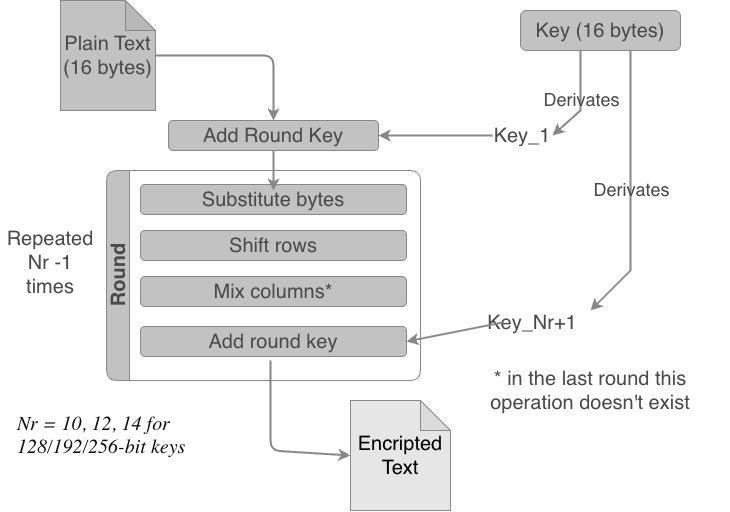
AddRoundKey, followed by \(N_r-1\) intermediate rounds (SubBytes, ShiftRows, MixColumns, AddRoundKey), and a final round that omits MixColumns.
This means that an AES with \(N_r\) rounds needs \(N_r+1\) 128-bit subkeys: one for the initial AddRoundKey, plus one per round. These subkeys are not independent fragments of the original key, but are generated by a key expansion schedule, which works with 32-bit words (4 bytes). In AES-128, with 10 rounds, 11 subkeys of 4 words each are needed, that is, 44 words, \(w_0\) to \(w_{43}\); in AES-192 there are 52 words, and in AES-256 there are 60 (National Institute of Standards and Technology 2001). The first four words are the key itself, which is why the initial AddRoundKey uses the original key. Each subsequent word is obtained by XORing the previous word with the one four positions back; every fourth word, the previous word first goes through a rotation of its bytes, the same S-box as SubBytes, and an XOR with a fixed round constant. Decryption uses exactly the same subkeys, but in reverse order, from last to first, because it undoes the rounds in the opposite order; what matters is to retain that all subkeys derive from a single secret key, and that their generation is deterministic and public, just like the rest of the algorithm’s structure: the security of AES resides entirely in the key, never in the secrecy of the design, exactly as Kerckhoffs’s principle demands.
3.5 Security of AES
Since its standardisation in 2001, AES has been subjected to intense, ongoing cryptanalytic scrutiny, without any attack of practical use being found. The best known result, from 2011, recovers an AES-128 key with about \(2^{126}\) operations instead of \(2^{128}\), that is, four times faster than brute force, but it requires an absurd amount of plaintext–ciphertext pairs, of the order of \(2^{88}\) bits (Aumasson 2017). The minimum key space, \(2^{128}\), makes pure brute force astronomically infeasible, far beyond what was already the case for DES.
In practice, the real vulnerabilities associated with AES are not mathematical, but implementation-related: side-channel attacks, which exploit indirect information, such as the execution time or the energy consumption of a device performing the encryption, rather than attacking the algorithm itself. The classic example is cache-timing attacks. Software implementations of AES use tables stored in memory, and the table element read at each step depends on the key. The time this access takes varies depending on whether or not the element is already in the processor’s cache memory, so measuring execution times reveals information about the elements read and, through them, about the key (Aumasson 2017). This is why modern processors include instructions dedicated to AES, such as the AES-NI set, which compute a complete round in the circuit itself, without tables in memory, and thus solve cache-timing attacks (Aumasson 2017). On their own, they do not solve attacks that measure the device’s energy consumption.
It is also worth anticipating a question about quantum computing. Grover’s algorithm, an algorithm for quantum computers, can find one value among \(n\) possible values in time proportional to \(\sqrt{n}\), instead of \(n\). Applied to searching for an AES-128 key, it reduces the effort from about \(2^{128}\) to about \(2^{64}\) steps (Aumasson 2017), a value now considered insufficient. This is why AES-256, despite being slower, is the recommended choice for data that must remain protected over the very long term: even with Grover’s algorithm, the effort remains about \(2^{128}\) steps.
3.6 Modes of Operation
A block cipher, whether AES or DES, encrypts exactly one block at a time. A real message almost never has exactly the size of a block (128 bits, in the case of AES) — it is usually larger, sometimes much larger. A mode of operation defines how to repeatedly apply the same block cipher to a sequence of blocks, so as to encrypt a message of any size.
3.6.1 ECB — Electronic Codebook
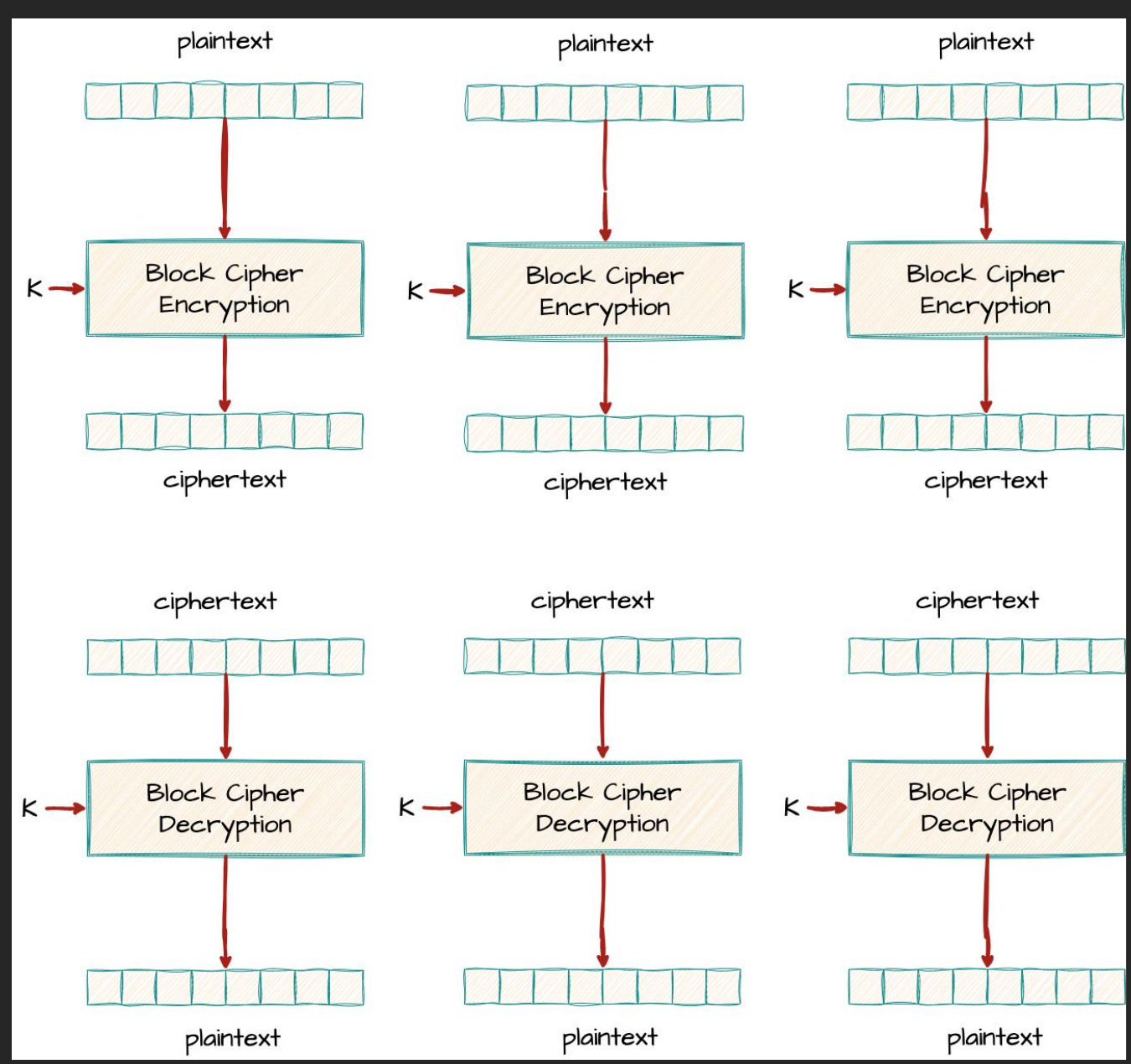
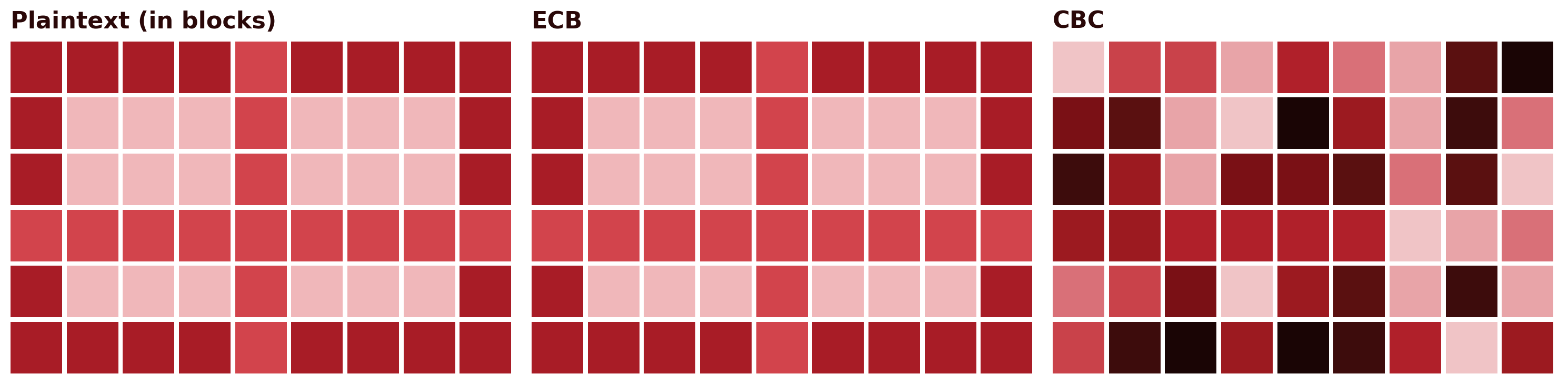
The simplest mode splits the message into blocks and encrypts each one independently, with the same key: \(C_i = E_K(P_i)\). It is simple and parallelisable, but has a serious flaw: identical plaintext blocks always produce identical ciphertext blocks. This is exactly the same underlying problem already seen in the monoalphabetic cipher, only at the level of 128-bit blocks instead of individual letters: any pattern or structural repetition in the original message remains visible in the ciphertext, even without decrypting anything.
3.6.2 CBC — Cipher Block Chaining
CBC solves this problem by chaining the blocks together: before encrypting each plaintext block, it is combined by XOR with the previous ciphertext block.
\[C_i = E_K(P_i \oplus C_{i-1})\]
Since there is no “previous block” for the first block of the message, an initialization vector (IV) is used: a random block, generated afresh for each message, which stands in for \(C_0\). The IV need not be secret, only unique and unpredictable, and is normally transmitted in the clear alongside the ciphertext.
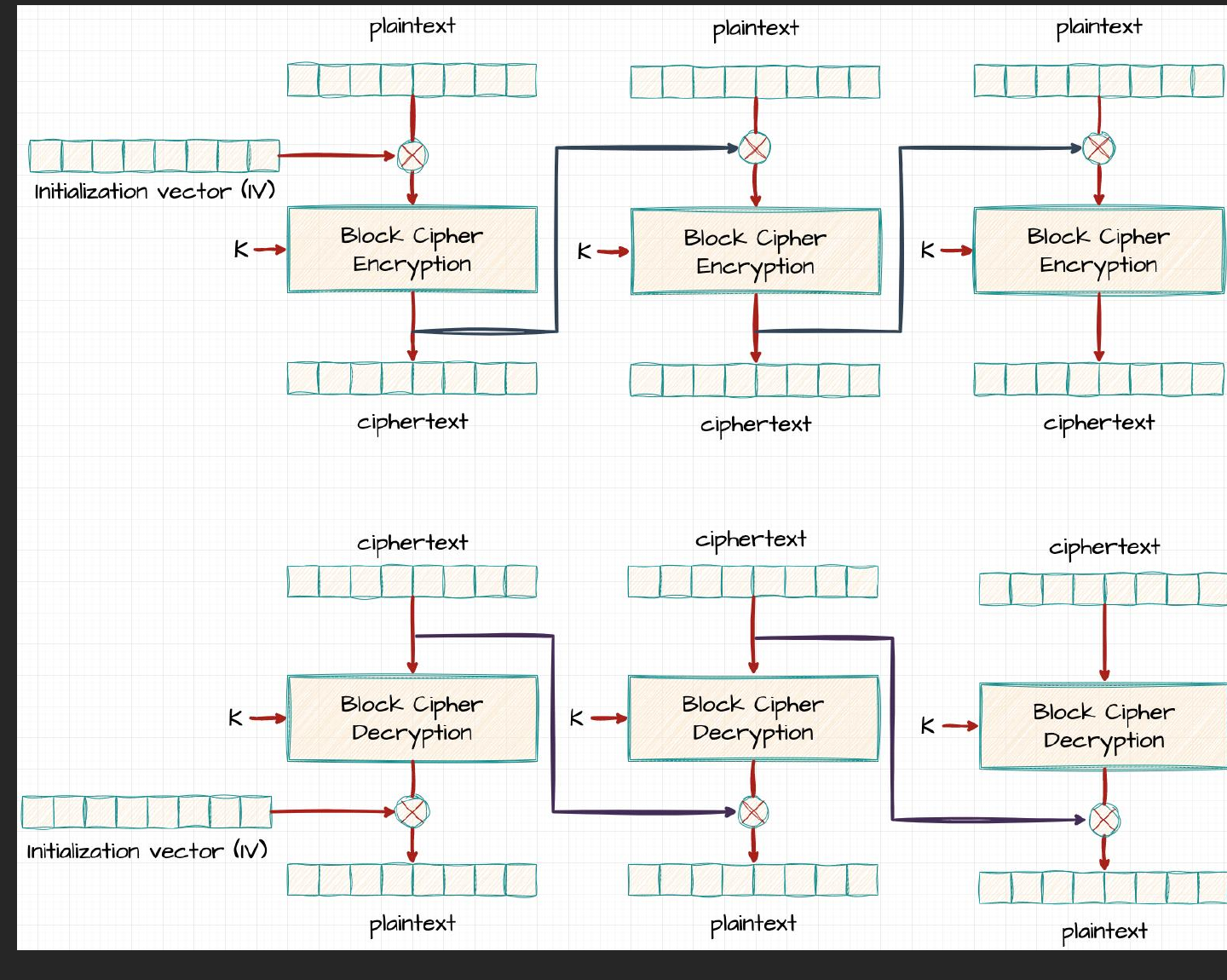
Since each encrypted block depends on all the preceding plaintext blocks (through the chain of XORs), identical plaintext blocks no longer produce identical ciphertext blocks, as seen in Figure 3.8: the original pattern disappears completely. Decryption reverses exactly this process:
\[P_i = D_K(C_i) \oplus C_{i-1}\]
Note an asymmetry between the two directions: decryption in CBC is parallelisable, because each decrypted block only depends on the previous ciphertext block, already available in full; encryption, by contrast, is not, because each block can only be encrypted once the previous one is ready, since it is its result that feeds into the next link of the chain.
3.6.3 CFB — Cipher Feedback Mode
CFB achieves an effect similar to CBC, eliminating the ECB pattern, but by a different route: instead of encrypting the plaintext directly, the previous ciphertext block is encrypted, and the result is combined by XOR with the plaintext to produce the next block.
\[C_i = P_i \oplus E_K(C_{i-1})\]
with \(C_0 = \text{IV}\). As in CBC, the IV cannot be reused, but it may be public.
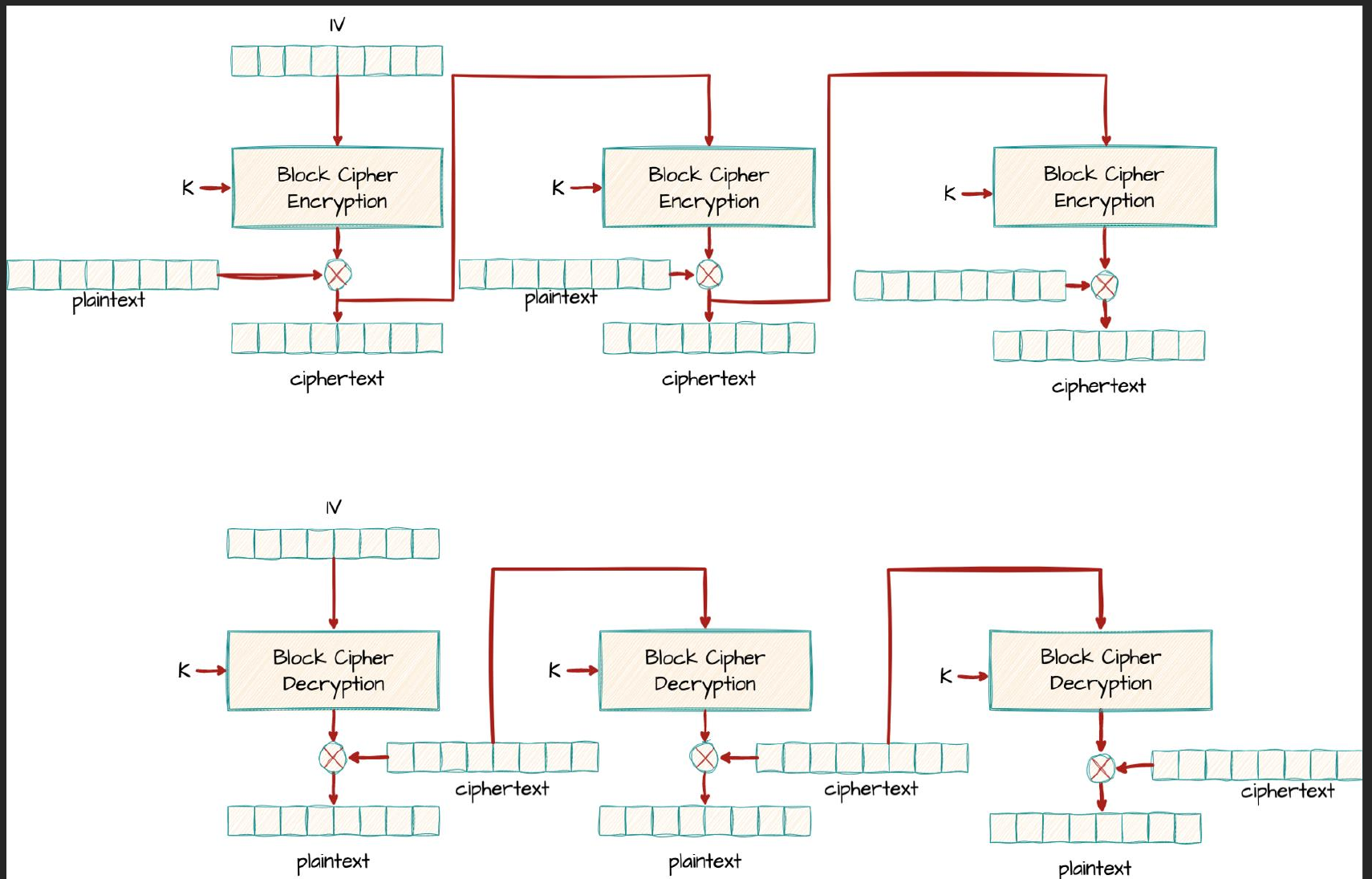 In practice, CFB behaves like a pseudo-stream cipher: instead of encrypting complete blocks, it can operate on smaller segments (for example, byte by byte), which makes it useful for data streams of variable length. As in CBC, encryption is not parallelisable, but decryption is.
3.6.4 CTR — Counter Mode
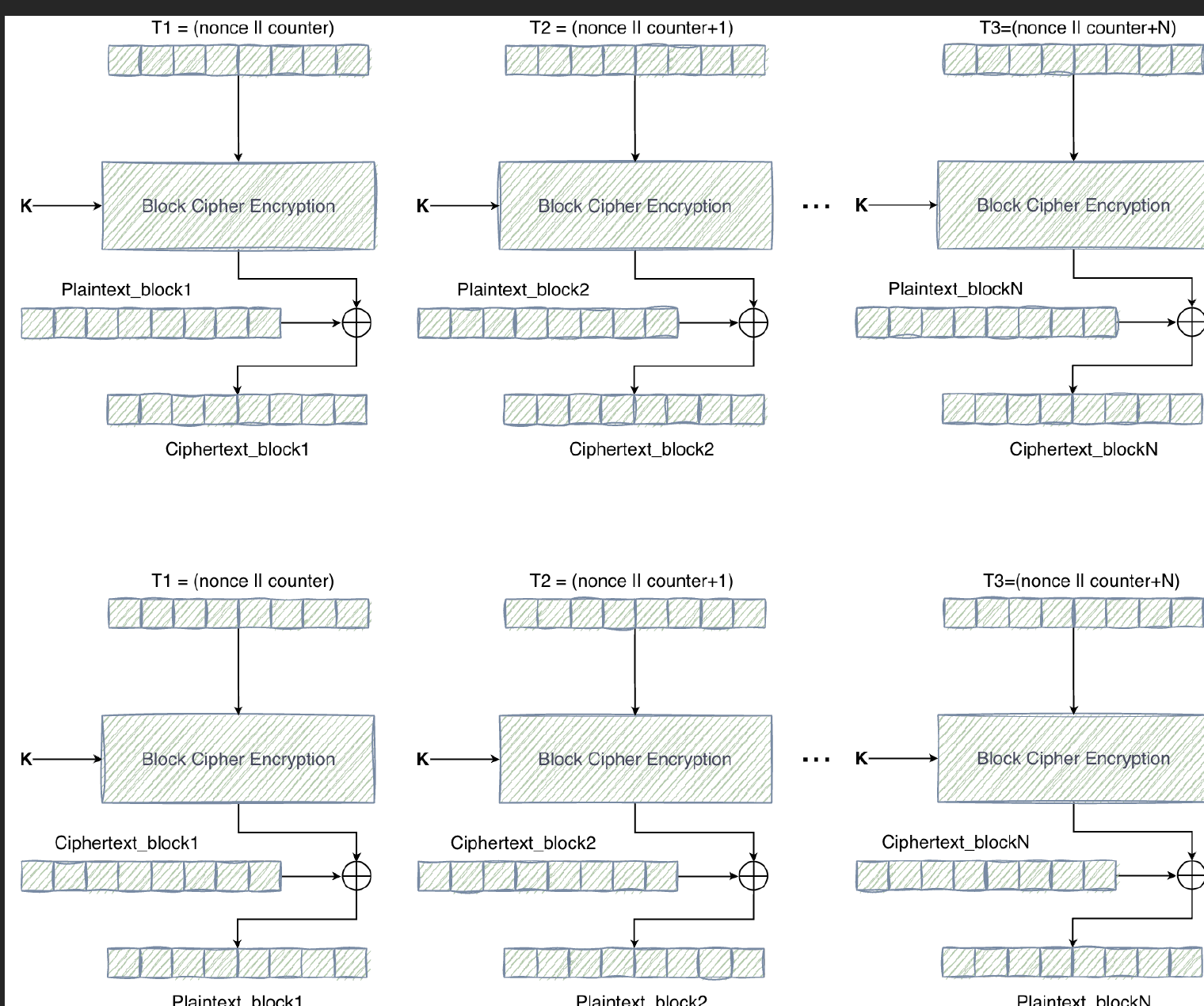
CTR follows a different approach: instead of encrypting the plaintext directly, a counter is encrypted (combined with a value unique to the message, the nonce), and the result is combined by XOR with the plaintext:
\[C_i = P_i \oplus E_K(\text{nonce} \mathbin\Vert i)\]
Block Cipher Encryption.
This effectively turns a block cipher into a stream cipher: each output block of \(E_K\) acts as a pseudo-random bit sequence, generated independently of the plaintext. The most relevant practical advantage is that, unlike CBC and CFB, both encryption and decryption in CTR are entirely parallelisable: block \(i\) does not depend on block \(i-1\), only on the counter itself, which translates into significantly higher performance on modern, multi-core hardware.
This performance gain has two important trade-offs. First, reusing the same nonce is catastrophic: reusing it produces the same pseudo-random stream for two different messages, and an attacker who XORs the two ciphertexts cancels that stream and obtains the XOR of the two plaintexts, which is often enough to recover both. Second, CTR is malleable: since encryption acts on the counter, not on the plaintext, the diffusion property of AES never gets to act on the relationship between ciphertext and plaintext. An attacker who alters a bit of the ciphertext alters exactly the corresponding bit of the decrypted plaintext, in a predictable way, with nothing in CTR to detect it.
None of the modes presented so far, ECB, CBC, CFB or CTR, protects the integrity of the message. The very standard that defines them calls them confidentiality modes (Dworkin 2001): they prevent an attacker from reading the message, but not from altering it. An attacker who intercepts the ciphertext can modify it, and the receiver decrypts the tampered version without noticing.
CTR is the extreme case. Flipping a bit of the ciphertext flips exactly the same bit of the decrypted plaintext, and no other (Dworkin 2001, Appendix D): the attacker chooses, bit by bit, the effect they want to produce. This is why the standard for AES-CTR in IPsec deems it trivial to forge an AES-CTR ciphertext and requires it to be used with authentication (Russell Housley 2004). CBC is not protected either: a bit flipped in one block garbles that block on decryption, but predictably flips the same bit of the next block (Dworkin 2001, Appendix D).
To detect changes, an authentication tag must be attached to the message: a short value computed from the message and from a secret key known only to the sender and the receiver. The algorithm that computes this tag is called a MAC (message authentication code). The receiver recomputes the tag over the message received and compares it with the one attached: if they do not match, the message is rejected, and the attacker, without the key, cannot compute the right tag for an altered message.
Rule of thumb: a confidentiality mode is never used on its own. It must be accompanied by an authentication tag, and the simplest way to guarantee this is to use a mode that does both in a single construction, such as GCM, presented next. Current protocols follow this rule: TLS 1.3, for example, accepts only modes of this kind (Rescorla 2018).
3.6.5 GCM — Galois/Counter Mode
GCM (Galois/Counter Mode) solves the integrity problem within the mode of operation itself: it extends CTR mode, from which it inherits confidentiality and full parallelisation, with a MAC of its own, GHASH. The result is an authenticated cipher, or authenticated encryption with associated data (AEAD): it produces, besides the ciphertext, a 128-bit authentication tag, computed not only over the ciphertext but also over the additional authenticated data (AAD). These are parts of the message that must travel in the clear but must not be changed, such as network headers, which network equipment needs to read in order to forward the message. Any alteration, to either the ciphertext or the AAD, invalidates the tag.
The name GHASH comes from Galois hash. It is the part of GCM that computes the tag, and it works as a chain: it runs over the AAD, each ciphertext block and, finally, a block holding the lengths of both; at each step, it XORs the next block into the accumulated value and multiplies the result by a value \(H\). That value is \(H = E_K(0^{128})\), the block of 128 zeros encrypted under the key: since it depends on the key, it is secret, and that is what prevents an attacker from computing the tag of an altered message. The multiplication by \(H\) has two purposes. Since the accumulated value is multiplied by \(H\) again at each step, each block ends up multiplied by a different power of \(H\) (the last by \(H\), the one before by \(H^2\), and so on), so the tag depends not only on all the blocks but also on the position of each one; if the blocks were merely combined by XOR, swapping two of them would leave the tag unchanged. Moreover, with XOR alone an attacker could predict the effect of any change on the tag; multiplied by a secret value, they no longer can (Dworkin 2007). “Galois” refers to the arithmetic used in this multiplication, a special arithmetic over 128-bit blocks called a Galois field, \(GF(2^{128})\), whose details are not needed here; “hash” refers to the fact that the result summarises all the blocks in a single 128-bit value.
Figure 3.11 shows how the two parts fit together. At the top is the familiar CTR mode: the counters \(\text{nonce} \Vert 2\), \(\text{nonce} \Vert 3\), … are encrypted under key \(K\) and combined by XOR with the plaintext blocks. At the bottom is the GHASH chain. The first counter, \(J_0 = \text{nonce} \Vert 1\), encrypts no data: its encryption serves only to mask, by XOR, the output of GHASH, and that is what produces the tag.
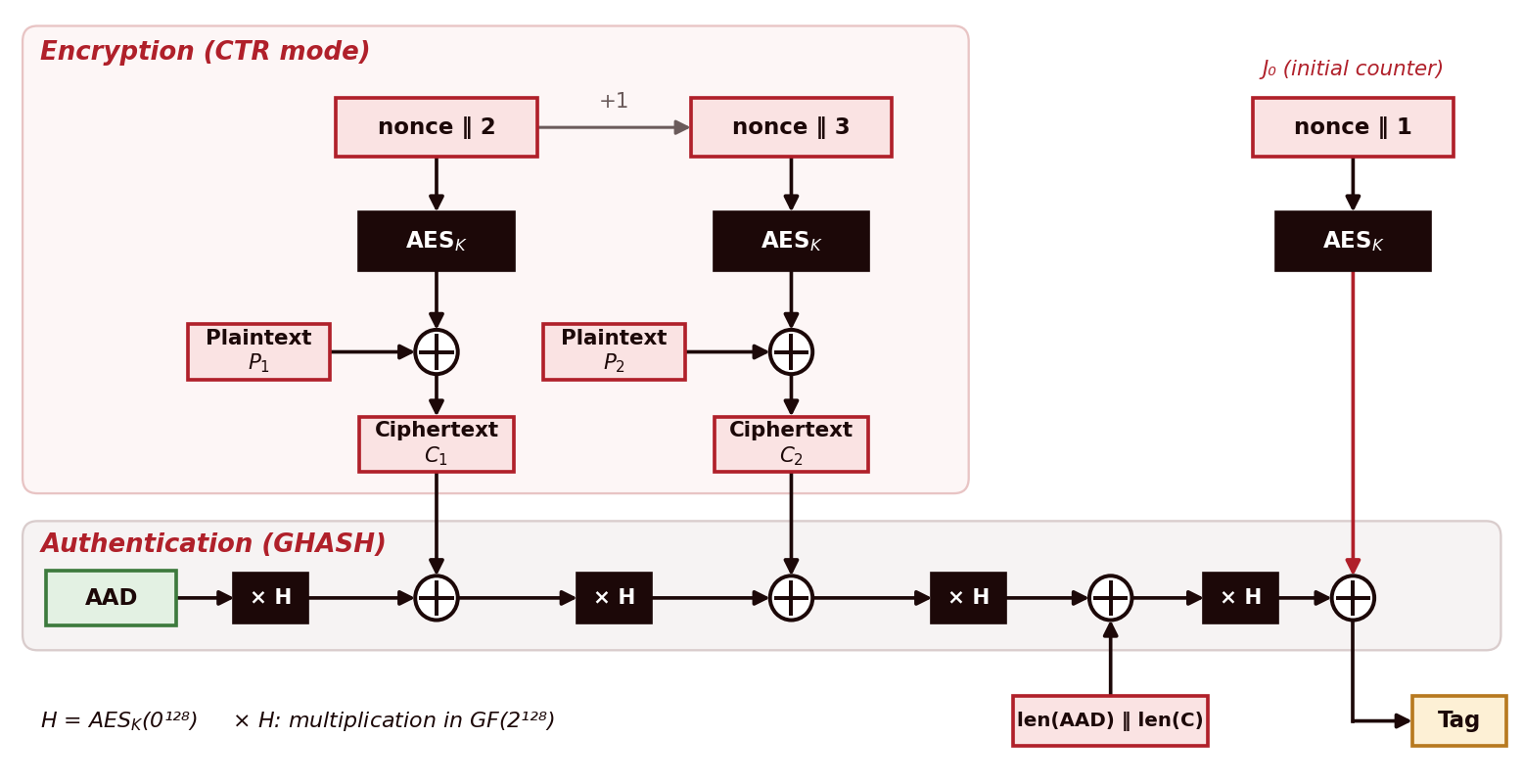
What travels on the channel is therefore three components (Figure 3.12): the AAD, in the clear but authenticated; the ciphertext, confidential and authenticated; and the tag. The receiver, who knows the key, repeats the GHASH computation over the received AAD and ciphertext and compares the result with the tag: if they differ in a single bit, the message is rejected before it is decrypted.

As in CTR, reusing the nonce (recommended at 96 bits) in GCM is catastrophic, and has already been exploited in practical forgery attacks against real TLS implementations (Böck et al. 2016). By combining confidentiality, integrity and full parallelisation, GCM is today the recommended mode for the generality of new applications, used, among others, in TLS 1.3, SSH, IPsec and QUIC.
3.6.6 Comparison of modes of operation
| Mode | IV / nonce | Parallelisable (encrypt / decrypt) | Padding | Native authentication | Recommended use |
|---|---|---|---|---|---|
| ECB | None | Yes / Yes | Yes | No | Never (reveals patterns) |
| CBC | Random IV | No / Yes | Yes | No | Legacy use; replace with AEAD |
| CFB | Random IV | No / Yes | No | No | Variable-length data streams |
| CTR | Unique nonce | Yes / Yes | No | No | High throughput, no authentication needed |
| GCM | Unique nonce (96 bits) | Yes / Yes | No | Yes (GHASH, 128 bits) | Recommended (TLS 1.3, SSH, IPsec, QUIC) |
3.7 Padding
A block cipher, such as AES, always encrypts a fixed-size block, 128 bits (16 bytes). Not every message has a length that is an exact multiple of that size: when the last block of a message is incomplete, the encryption algorithm does not have enough bytes to process it.
Padding solves this by adding extra bytes to the end of the message, before encryption, to complete that last block. The most common scheme is PKCS#7: if \(n\) bytes are missing to complete the block, \(n\) bytes are appended, all with the value \(n\). For example, if 10 bytes are missing to complete the block, ten bytes are appended, all with the value 0x0A. There is a rule that is easy to forget: if the message length is already an exact multiple of the block size, a full block of padding is still appended, 16 bytes with the value 0x10. It is this rule that allows decryption to always read the last received byte and know exactly how many bytes to remove, with no ambiguity (Russ Housley 2009): without it, a message that happened to end in the byte 0x01 would lose that byte on decryption, mistaken for padding.
Not all the modes presented in this chapter need padding: only those that encrypt the plaintext directly, block by block, such as ECB and CBC (Table 3.1). CTR and GCM, by turning the block cipher into a kind of stream cipher, combining it with the plaintext via XOR instead of applying it directly, dispense with it entirely: they can encrypt messages of any length, byte by byte, without ever needing to complete a final block.
It is worth flagging, at this point, an important security consequence: a poorly implemented padding validation, one that reveals to an attacker, through an error message or a difference in response time, whether the received padding was valid or not, can be exploited to decrypt entire messages without ever knowing the key, byte by byte, through the so-called padding oracle attack. The underlying lesson is one that recurs throughout this book: a mathematically correct mechanism can still fail because of how it is implemented.
3.8 Chapter Summary
This chapter presented the algorithm that today occupies the place of DES, and the way it is applied to messages of any size:
- AES resulted from a public NIST competition, won by the Rijndael algorithm, and standardised in 2001
- Unlike DES, AES is not a Feistel network: it is a substitution-permutation network (SPN), in which every round transforms the entire block
- The block is always 128 bits; the key may be 128, 192 or 256 bits, with 10, 12 or 14 rounds, respectively
- Each round applies four transformations: SubBytes (confusion, via a non-linear S-box), ShiftRows and MixColumns (diffusion, between and within columns), and AddRoundKey, the only step that uses the key; the security of AES comes from alternating the XOR with the key and the public scrambling of the other three transformations
- To date, there is no cryptanalytic attack of practical use against AES (the best, from 2011, needs about \(2^{126}\) operations and an absurd amount of data); the real vulnerabilities are implementation-related, such as cache-timing attacks, which the AES-NI instructions solve
- A mode of operation defines how to apply a block cipher to messages larger than a single block: ECB is simple but reveals structural patterns; CBC and CFB chain the blocks and eliminate them, at the cost of encryption not being parallelisable; CTR encrypts a counter and combines the result with the plaintext by XOR, which makes it fully parallelisable, but means the nonce must never be reused and the plaintext can be changed bit by bit
- Confidentiality is not integrity: none of these modes prevents the ciphertext from being altered undetected (in CTR, the attacker flips exactly the bits they want); a confidentiality mode is therefore never used on its own, but always together with a MAC, which computes an authentication tag
- GCM combines CTR with GHASH, a MAC that runs over the AAD and the ciphertext multiplying the accumulated value by a secret value \(H\), in an AEAD construction that is today the recommended mode for most new applications
- Padding (namely the PKCS#7 scheme) allows the modes that encrypt directly, block by block, such as ECB and CBC, to process messages of any length, adding a full block when the message is already a multiple of the block size; CTR and GCM dispense with it. An implementation that reveals whether the received padding is valid opens the door to padding oracle attacks
3.9 Discussion Question
DES combines confusion and diffusion through a single function \(F\), applied to only half the block per round. AES separates these two properties into distinct transformations (SubBytes for confusion, ShiftRows/MixColumns for diffusion), applied to the entire block. What advantages might this explicit separation bring, both for the security analysis of the algorithm and for its performance in hardware?